
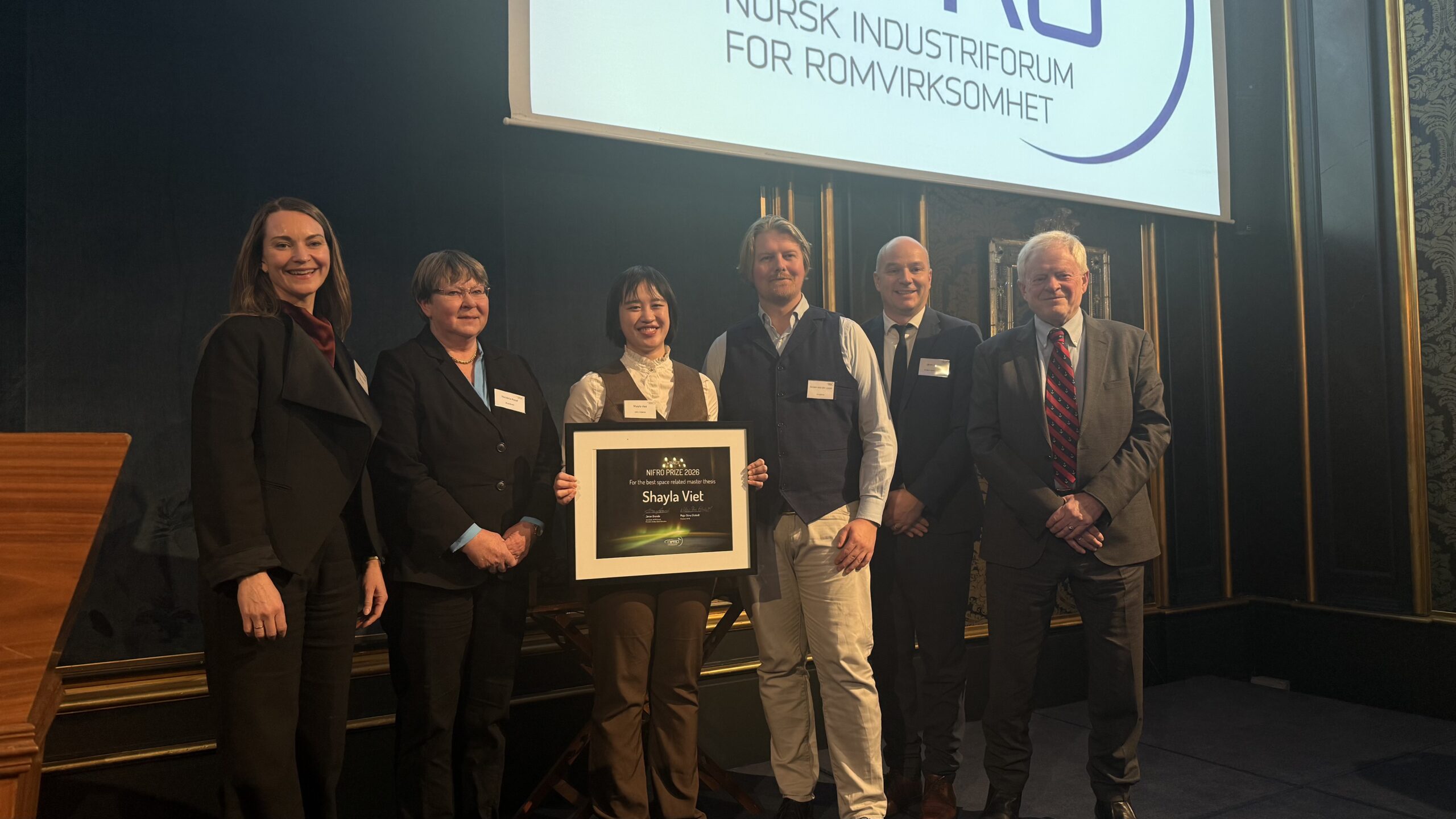
When the Norwegian space industry gathered for this year’s Space Dinner, the celebration of new talent was also in focus, and the NIFRO Award 2026 highlights the best master’s thesis within a field that is becoming increasingly important for the future of space exploration
The Norwegian Industry Forum for Space Activities (NIFRO) was established in 1986 by a group of Norwegian industrial companies and research institutions, among other things to create a common meeting arena. At the start of each year, the Space Dinner is held, which has become the annual conference of the Norwegian space industry.
As part of NIFRO’s work to highlight the societal value of a strong Norwegian space industry, and as a contribution to recruiting new talent to the space sector, the NIFRO Award was established in 2013.
“The intention was also to motivate and encourage master’s students to put in extra effort in their theses,” says Jøran Grande, head of the education department at Andøya Space, who collaborates with NIFRO on this recognition.
“This year, the award is being presented for the 12th time as part of the Space Dinner. All candidates have been evaluated by the jury according to three main criteria: that the candidate has demonstrated understanding, reflection, maturity, and analytical ability in their thesis; whether the candidate manages to see their work in a broader context; and the value it may bring to the Norwegian space industry.”
This year’s jury consisted of Simen Von der Lippe from KDA, Vendela Paxal from WideNorth, and Jøran Grande from Andøya Space.
This year’s winner
Among eight submitted theses, the winner clearly stood out.
“This year’s winner of the NIFRO Award is Shayla Viet from NTNU, who submitted the thesis ‘The SWEET method for complementing instrument data on solar energetic particle events at Mars,’” Grande says enthusiastically. “And then you might wonder: ‘What use do particles around Mars have for the Norwegian space industry?’”
“What both Earth and Mars have in common is space weather, and the thesis has further developed a method for predicting particle storms,” Grande explains.
Space weather deals with how the Sun affects the environments around planets, both in terms of radiation and emissions of electrically charged particles. These particles are, among other things, responsible for the Northern Lights here on Earth.
“Space weather poses challenges for satellites and other spacecraft, and Viet’s thesis can also be applied elsewhere in the solar system — including around our own planet. The jury was also impressed by Viet’s ability to place the work in a larger context, making her a worthy winner of this year’s award,” Grande concludes.
The award was presented by NIFRO President Maja-Stina Ekstedt, and includes a prize of NOK 20,000. Viet concluded by presenting her thesis to the Space Dinner participants.