
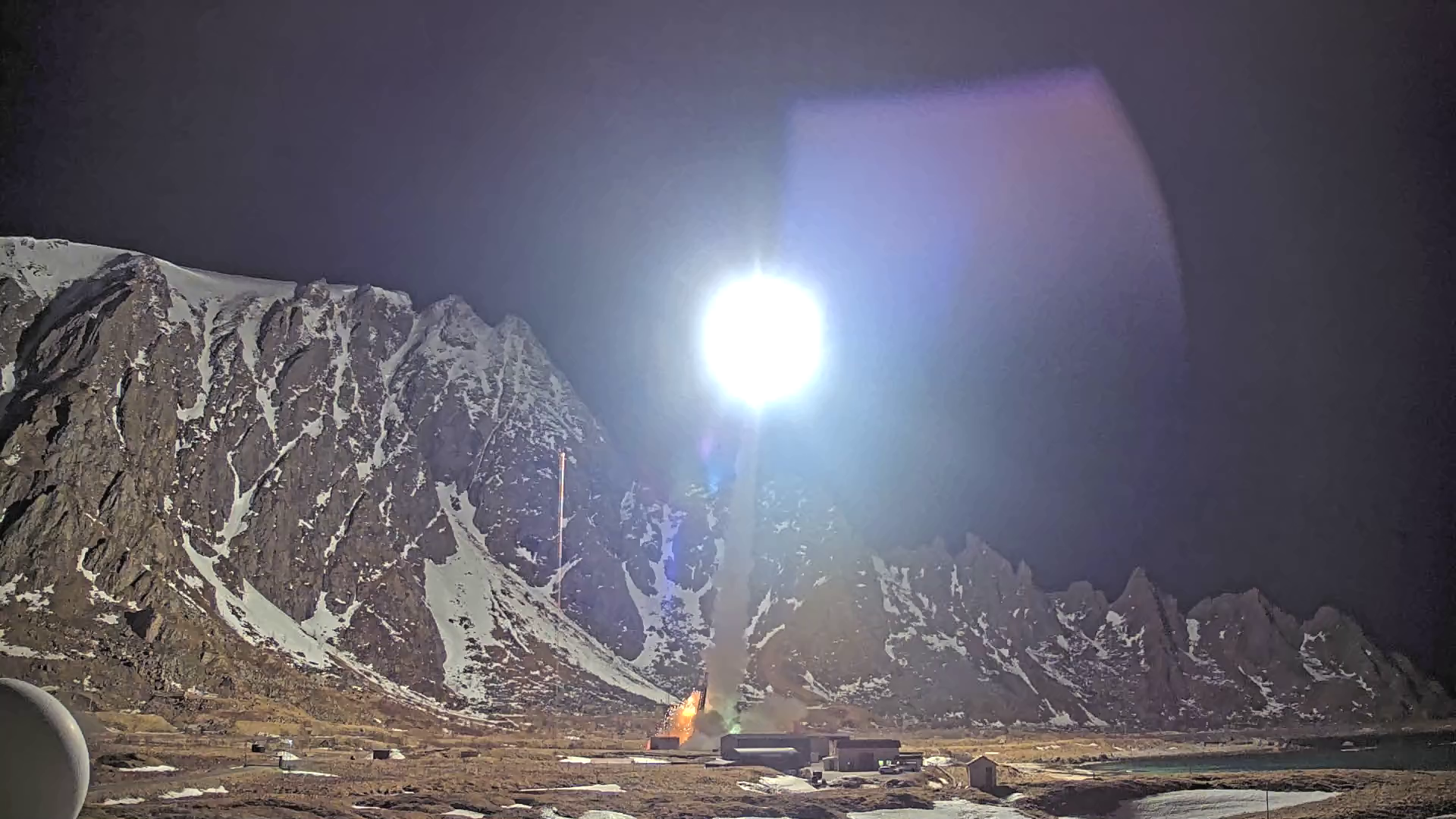
The Norwegian-built research rocket ICI-5b was sent into the aurora, carrying out detailed measurements of plasma turbulence. The collected data will be used in space weather research.
The Norwegian-built research rocket ICI-5b was launched from Andøya Space, Oksebåsen, on March 11, 2026 at 01:25 local time.
ICI-5b is a Norwegian research rocket, built by Andøya Space, supported by NASA, and carrying several scientific instruments developed by the Department of Physics at the University of Oslo, the Leibniz Institute of Atmospheric Physics (Germany), and the Department of Physics and Astronomy at the University of Iowa (USA).
The project is funded by the Norwegian Space Agency, ESA PRODEX, and the ERC Consolidator Grant “Polar-4DSpace” from the EU.
A wealth of data
The mission of the research rocket was to fly through the aurora and conduct measurements related to turbulence in plasma and in the neutral part of the upper atmosphere.
“It was a great launch,” says Kolbjørn Blix, head of the sounding rocket department at Andøya Space. “ICI-5b was sent through an auroral outburst, reaching an altitude of 304 kilometers, and brought back a wealth of data from the flight, which was downloaded by our telemetry team.”
The data will be used in space weather research, which is an important part of ongoing fundamental science.
“When space weather is rough, it can cause radio signals to behave differently, satellite navigation to fail, and even onboard satellite electronics to malfunction. To understand how we can protect society from space weather, we must understand how space weather works.”
Now, the data from the research rocket will be analyzed and used in further efforts to better understand and predict space weather.
“It will be exciting to see what the research team discovers when they begin analyzing all the scientific data collected by the rocket,” Blix concludes.
The launch was broadcast live on Andøya Space’s YouTube channel. You can watch it here: