
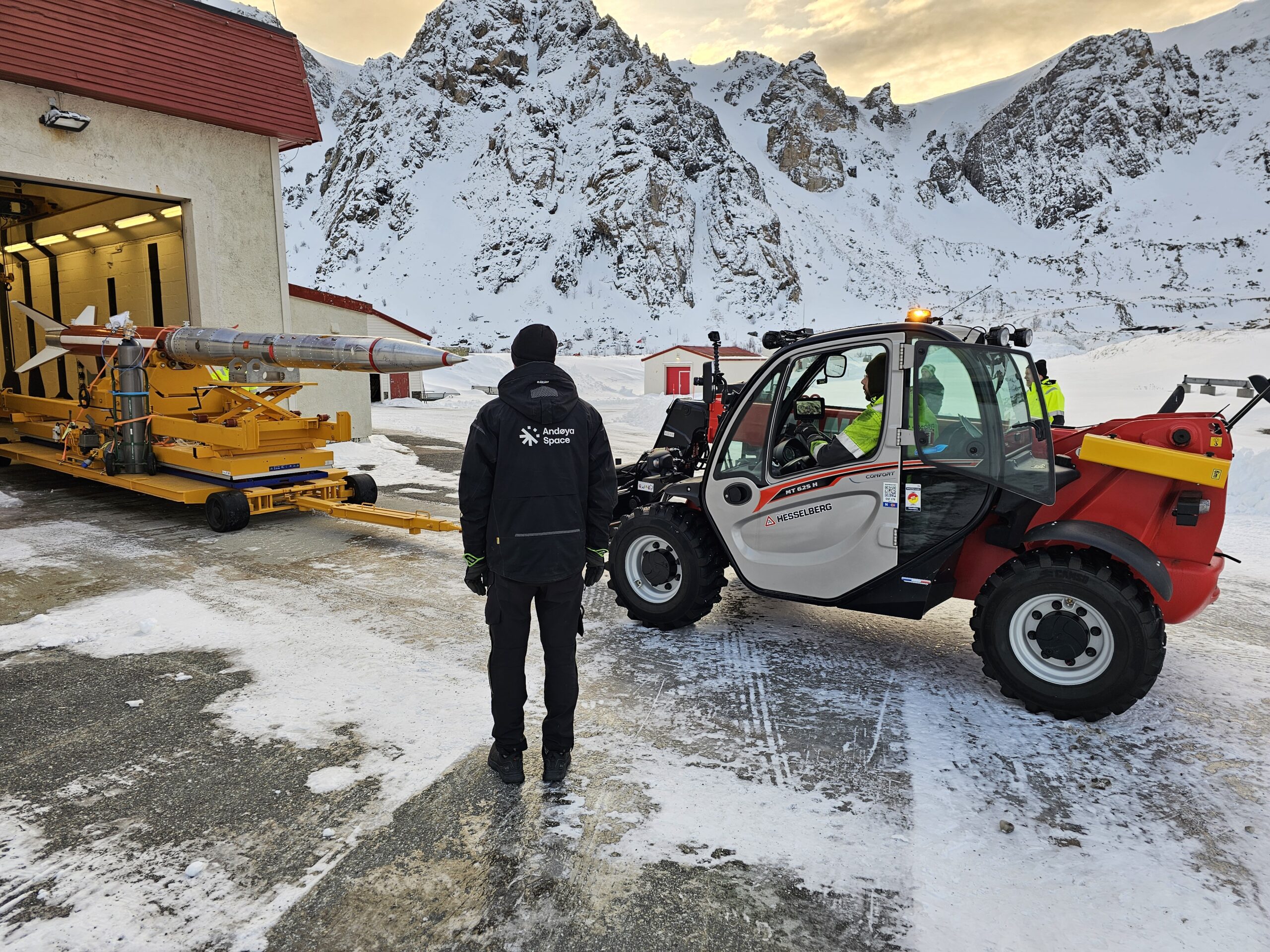
The research rocket ICI‑5b is ready for launch from Andøya, to provide scientists with new and precise insight into how plasma behaves inside the northern lights.
ICI‑5b is a Norwegian research rocket built by Andøya Space and carries several scientific instruments made by the Department of Physics at the University of Oslo, the Leibniz Institute of Atmospheric Physics, and the Department of Physics and Astronomy at the University of Iowa. The project is funded by the Norwegian Space Agency, ESA PRODEX, and the ERC Consolidator Grant “Polar‑4DSpace” from the EU.
What will the rocket do?
The mission of the research rocket is to fly through an auroral outbreak and take measurements related to turbulence in plasma. But what is plasma?
“Plasma is the fourth state of matter. Take iron, for example—normally it’s a solid. Heat it up, and it becomes liquid, then turns into a gas, and eventually the electrons are stripped from the atoms in the gas, and you end up with plasma.”
Kolbjørn Blix, head of the sounding rocket department at Andøya Space, attempts to describe what ICI‑5b will do that no previous research rocket has done.
“It is plasma from the Sun that creates the Northern Lights here on Earth. ICI‑5b will make the most accurate measurements of turbulence in plasma,” says Blix. “There has been a major Norwegian breakthrough in the design of the most commonly used instrument for measuring plasma—the so‑called Langmuir probes. These probes have gone from being the size of golf balls to the size of sewing needles, and they’ve also gone from making measurements once per second to several times per second—a 1000‑fold improvement in resolution.”
This is crucial for a research rocket traveling at several thousand kilometers per hour.
“This means the new Norwegian instruments can take measurements on the centimeter scale inside the aurora, instead of once per kilometer,” Blix explains. “This will give scientists much better insight into the physical processes occurring during auroral events.” At these altitudes, plasma turbulence is connected to turbulence in the neutral atmosphere, and scientists will also study this coupling and energy transfer.
Why are we doing this?
It was a Norwegian scientist, Kristian Birkeland, who in the late 1800s discovered that the aurora is caused by the Sun. Today we understand that the aurora is the final, visible part of what we call space weather.
“Space weather strongly affects modern society,” says Blix. “Radio signals behave differently, satellite navigation can fail, and not least, electronics aboard satellites can malfunction. To understand how we can protect society from space weather, we must understand how space weather works. This is very important fundamental research.”
The researchers also aim to better understand how energy from the Sun moves through the atmosphere, and how the ionized part is connected to the neutral atmosphere. That’s why ICI‑5b carries instruments measuring both plasma and turbulence in the neutral upper atmosphere.
Built in Norway
When ICI‑5b stands ready on the launch pad at Andøya, it will measure 12 meters in height and consists of two rocket motors and a payload section.
“The two motors are off‑the‑shelf units delivered by NASA, and their job is to lift the payload section into the aurora,” says Blix. “The payload section contains the scientific instruments from the universities and ensures all measurement data is transmitted back to our ground stations. This section is built in Norway, here at Andøya Space, by our engineers.”
“ICI‑5b has undergone hours of testing to qualify it for launch. We have performed functional tests, spin tests, and vibration tests to ensure it can survive the shaking and vibrations during launch,” Blix says enthusiastically.
Why a research rocket and not a satellite?
Even in an era with many satellites in orbit, research rockets are still necessary.
“There are several reasons for that,” says Blix. “The first reason is that the altitude range ICI‑5b will investigate is below 300 kilometers—a very difficult region for satellites. At 300 kilometers, there is still enough atmosphere to slow satellites down so much that they would quickly fall out of orbit.”
“The second reason is simply timing. A research rocket can wait patiently for the aurora on the launch pad and arrive in five minutes. A satellite, however, might be on the other side of the planet when the right conditions occur.”
“Research missions like this use data from many sources to determine the exact right moment to launch—both satellites and ground‑based instruments, such as ALomar and EISCAT,” Blix concludes.
Livestream
The launch of ICI‑5b will be livestreamed on Andøya Space’s YouTube channel.