
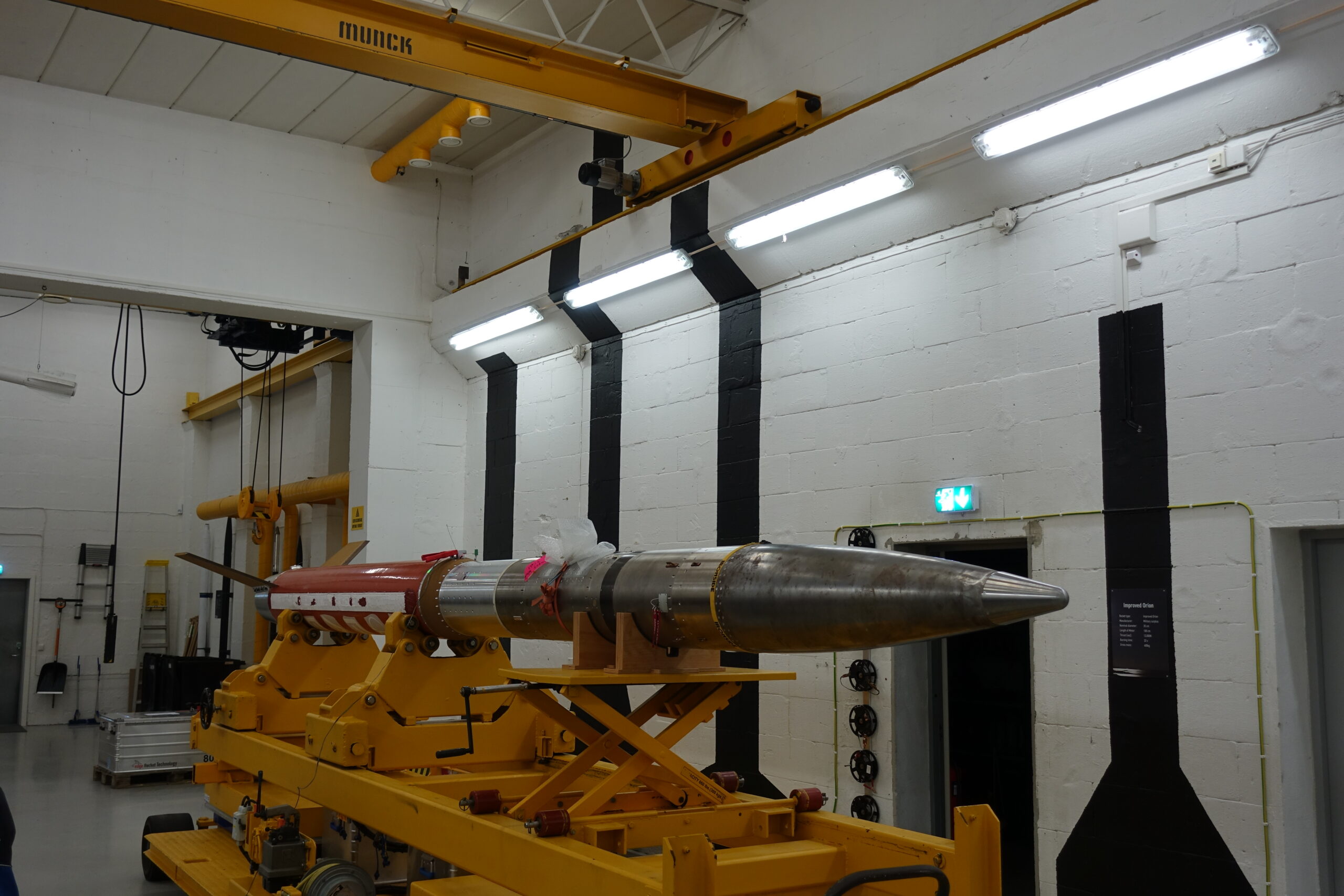
A German research project called DEFINE will study a region of the atmosphere that scientists still know relatively little about.
Most of us rarely think about the fact that we live our lives surrounded by an atmosphere. We take it for granted and usually only notice it through the weather. Yet weather occurs only in the lowest eight kilometers of the atmosphere, which extends hundreds of kilometers beyond Earth’s surface.
Despite many decades of atmospheric research, there is still a great deal we do not know about it.
Important basic research
«You know, everything is connected in one way or another,» says Sigve Haugsnes, head of sounding rockets at Andøya Space. «The atmosphere not only affects life on Earth through weather and climate, but also satellites and spacecraft in orbit. That is why it is important to understand it.»
«This is basic research, which in this case means acquiring new knowledge and a deeper understanding of the atmosphere without necessarily aiming for an immediate and specific practical application,» Haugsnes explains. «The goal is to build a foundation for long-term benefits, which is extremely important for science.»
DEFINE
The German research project DEFINE will investigate a region of the atmosphere extending from approximately 50 to 160 kilometers in altitude, often considered the middle region of the atmosphere. This area includes the mesosphere and lower thermosphere, commonly abbreviated as M/LT.
DEFINE stands for: Density Field in the MLT: Neutrals, Electrons, and trace gases. Radiative and dynamical balance.
«The researchers will launch an advanced sounding rocket from Andøya that will travel to an altitude of just over 150 kilometers, carrying out measurements along the way,» Haugsnes explains. «They hope to achieve the first highly precise simultaneous measurements of atmospheric gases, charged particles, atomic oxygen, and temperature. The goal is to create a more comprehensive understanding of how this part of the atmosphere works and how energy transfer and chemical processes influence it.»
The Alomar Observatory will contribute measurements from the same region through which the rocket will fly. At the same time, a German research aircraft named HALO will circle around Andøya and carry out additional measurements.
Launch from Andøya
The sounding rocket is scheduled to be launched from Andøya sometime between November 30th and December 12th. Haugsnes explains that the rocket will land in the ocean under parachute.
«We will recover it after splashdown and bring it back to shore so that it can be used again at a later date.»
He also informs that the launch will be streamed live on Andøya Space’s YouTube channel.
«We will share a link to the live broadcast on our social media channels so that anyone interested can follow real-world rocket science in action,» Haugsnes concludes.
Who Is Involved?
The research project is led by the Leibniz Institute of Atmospheric Physics (IAP) in Germany. The rocket was built by the German Aerospace Center (DLR) through its sounding rocket division (Mobile Rocket Base). The launch will be carried out in collaboration with Andøya Space.
Other participating research institutions include:
- IRS (Institute of Space Systems)
- MISU (Department of Meteorology, Stockholm University)
- DLR Institute of Atmospheric Physics